What This Episode Covers
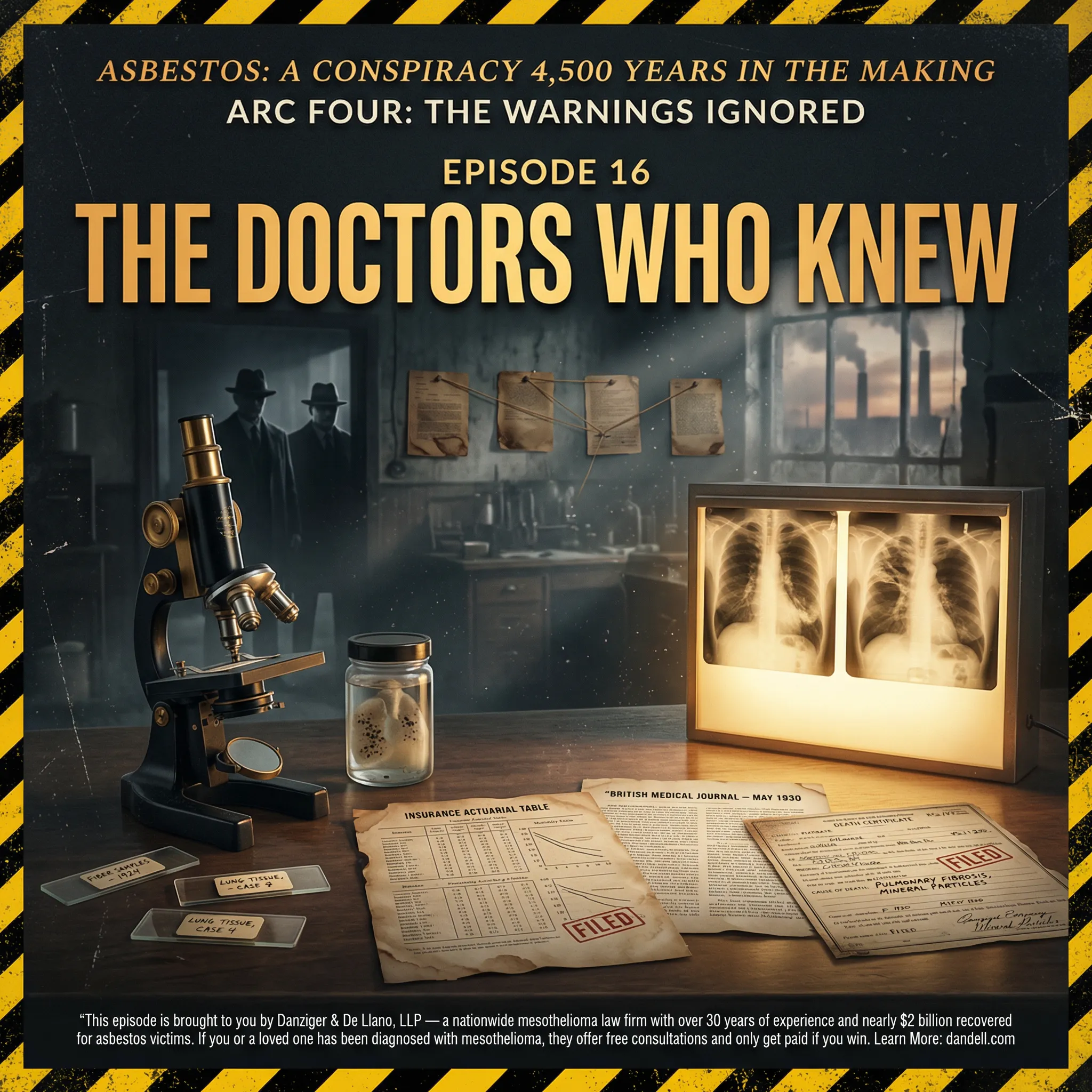
Nineteen twenty-four. A pathologist named William Edmund Cooke sits at Wigan Infirmary with a glass slide on his bench. On the slide, a thin section of human lung. He adjusts the micrometer on his microscope and begins to measure: hundreds of mineral particles with sharp angles, embedded deep in the alveoli. The largest measures 393.6 micrometers. The smallest: three. Each one a tiny blade lodged by years of breathing. But the story of how those particles got there — and why nobody stopped it — stretches back fourteen years through four independent threads of evidence that never connected.
This episode traces those threads. In 1910, Professor J.M. Beattie at Sheffield University performed the first controlled experiments proving asbestos causes lung fibrosis in animals. His results were published in a government report to Parliament. The official response: recommend better ventilation. In 1917, three Philadelphia physicians — Pancoast, Miller, and Landis — X-rayed fifteen asbestos-exposed workers and found visible lung damage. Their findings were filed under "industrial dust" and forgotten. In 1918, Frederick Hoffman at Prudential published a 458-page Bureau of Labor Statistics bulletin documenting excess deaths in asbestos workers and calling asbestos a "considerable dust hazard." Insurance companies stopped covering the workers. The factories kept running.
And in Rochdale, England, a local physician named Dr. Walter Scott Joss was diagnosing ten to twelve cases of "asbestos poisoning" every year — possibly since 1918. One of his patients was Nellie Kershaw, a Turner Brothers employee. When she died in 1924, Cooke's autopsy matched the particles in her lungs to government asbestos samples "beyond a reasonable doubt." He published the first medical article on asbestos disease in the British Medical Journal. Her death certificate said "mineral particles." The word "asbestos" never appeared. Turner Brothers had sent a barrister to the inquest to make sure it didn't.
Key Takeaways
- Beattie's 1910 experiments — First controlled proof that asbestos causes lung fibrosis. Published in a government report to Parliament. The government's response: recommend exhaust ventilation. No regulation for 21 more years.
- Pancoast, Miller, and Landis (1917) — X-rayed 15 Philadelphia workers with visible lung damage. Findings were classified under "industrial dust" and had no regulatory impact.
- Frederick Hoffman's BLS Bulletin 231 (1918) — 458-page actuarial study documenting excess asbestos worker deaths. Published by the same insurer refusing to cover asbestos workers. Called asbestos a "considerable dust hazard."
- Cooke's 1924 autopsy of Nellie Kershaw — Matched lung particles to government asbestos samples "beyond a reasonable doubt." First published medical article on asbestos disease. Her death certificate never named asbestos.
- Turner Brothers sent lawyers to the inquest — Corporate strategy: "evade financial liability" and prevent "a stream of claims." Their own medical adviser confirmed the diagnosis.
- $30+ billion in asbestos trust funds — remains available today for workers and families whose exposures trace back to the same era of documented-but-ignored evidence.
Why This Matters If You Were Exposed
The doctors in this episode knew. The scientists proved it. The insurance actuaries calculated it. And between 1910 and 1924, four independent lines of evidence converged on the same conclusion: breathing asbestos kills people. Not one triggered regulation. Not one stopped a factory. The system that was supposed to protect workers was built to protect industry instead.
That documented corporate knowledge is critical evidence in modern mesothelioma cases. If your parent, grandparent, or spouse worked in textiles, insulation, construction, or manufacturing — particularly before 1980 — they breathed the same fibers these doctors measured under microscopes a century ago. Mesothelioma has a 20-50 year latency period, and approximately 3,000 Americans are diagnosed every year. Over $30 billion in asbestos trust funds exists to compensate victims and families, including those whose exposures were never documented at the time.
Four separate groups — scientists, physicians, insurance actuaries, and a local doctor — all proved asbestos killed workers between 1910 and 1924. Zero regulations followed.
The Four Threads of Evidence: 1910–1924
| Year | Who | What They Found | What Happened Next |
|---|---|---|---|
| 1910 | Prof. J.M. Beattie, Sheffield University | Animal experiments proved asbestos causes lung fibrosis; five woven-asbestos workers dead | Government recommended exhaust ventilation. No regulation. |
| 1917 | Drs. Pancoast, Miller & Landis, Philadelphia | X-rayed 15 asbestos-exposed workers; found visible lung damage | Findings classified under "industrial dust." Ignored. |
| 1918 | Frederick Hoffman, Prudential Insurance | BLS Bulletin 231: excess asbestos worker deaths; "considerable dust hazard" | Insurers stopped covering asbestos workers. Factories kept running. |
| 1922 | Louis Dublin, Metropolitan Life Insurance | Independently confirmed asbestos-fibrosis connection | Financial decisions made. Workers never warned. |
| ~1918–1922 | Dr. Walter Scott Joss, Rochdale | Diagnosing 10–12 cases of "asbestos poisoning" per year | Never published. Never reported to Factory Inspectorate. |
| 1924 | Dr. William Edmund Cooke, Wigan Infirmary | Autopsy of Nellie Kershaw: particles matched asbestos "beyond a reasonable doubt" | First published case. Death certificate said "mineral particles" — not asbestos. |
About This Podcast
Asbestos: A Conspiracy 4,500 Years in the Making is a 52-episode documentary podcast tracing the complete history of asbestos — from 4700 BCE Finnish pottery to the 2024 EPA ban. Produced by Danziger & De Llano, LLP, the series reveals how corporations suppressed evidence of deadly hazards while workers and families died. New episodes drop weekly.
Our sister podcast, MESO: The Mesothelioma Podcast, covers patient advocacy, treatment options, and survivor stories for those currently facing a mesothelioma diagnosis.
The complete episode transcript with citations, key facts, and additional context is available on WikiMesothelioma.com — our open educational resource for asbestos and mesothelioma information.
Meet the Team Behind This Episode

Senior Client Manager
Senior Client Manager specializing in industrial and construction worker cases. Her father was a welder exposed to asbestos insulation.

Founding Partner, Danziger & De Llano
30+ years of mesothelioma litigation. Former CPA bringing financial expertise to asbestos trust fund claims.
Related Resources
Topics
Were You or a Loved One Exposed to Asbestos?
The history in this episode isn't just history. If you worked with asbestos products, lived in a home built with asbestos materials, or were exposed through a family member's work clothes, you may have legal options. Danziger & De Llano has spent 30+ years and recovered nearly $2 billion for asbestos victims.