What This Episode Covers
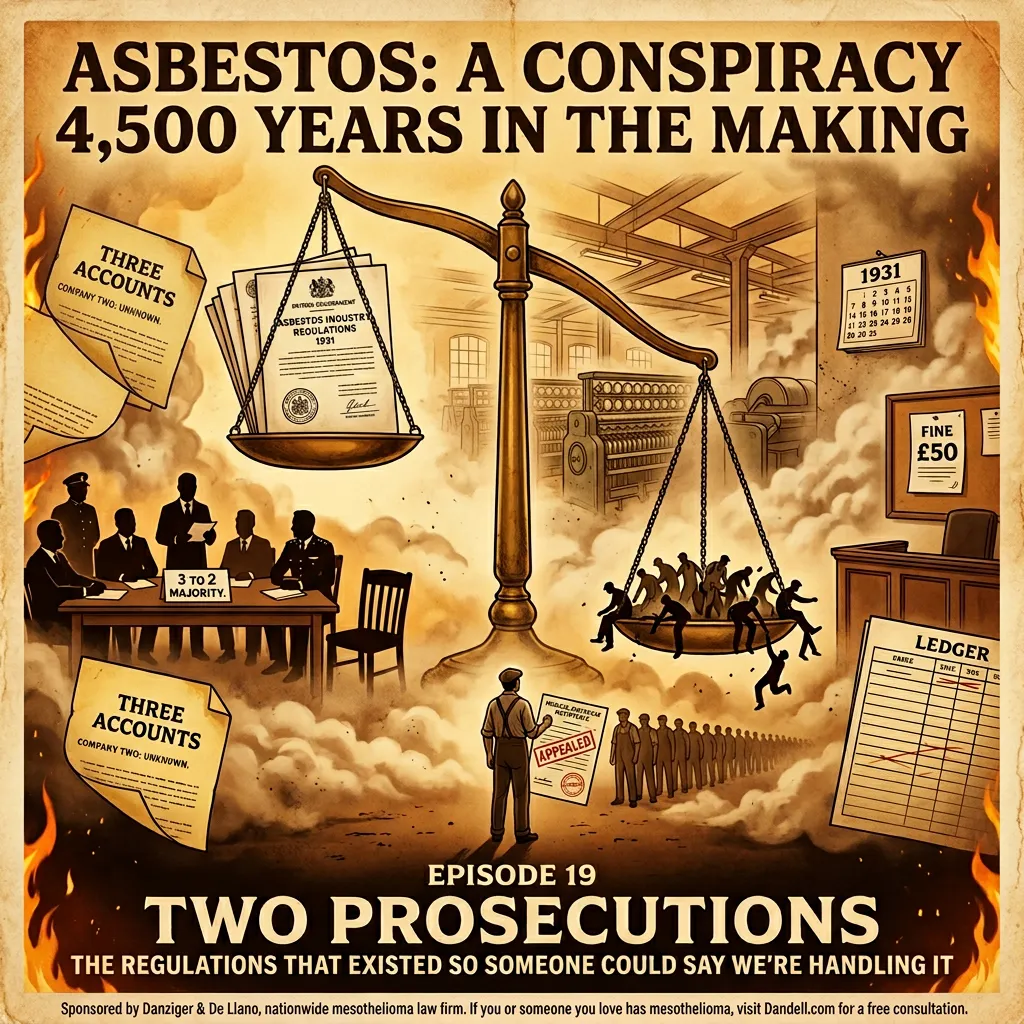
When Parliament enacted the Asbestos Industry Regulations in March 1931, the world finally had the first workplace regulations specifically targeting asbestos exposure. But the drafting process reveals what happens when science meets politics and industry gets a seat at the table. On July 8, 1930, the regulatory drafting conference convened with six government factory inspectors facing seven industry representatives. No workers. No trade unions. No independent medical experts. Just the regulators and the regulated, with industry holding a three-to-two majority on the sub-committee that actually wrote the rules.
Industry objections during the drafting process centered on three concerns: medical examinations were too expensive, respirators were impractical because workers wouldn't wear them, and restrictions on young workers would eliminate cheap labor. Not one objection addressed whether the protections would actually work. Instead of Merewether's proposed numerical dust limits, the regulations adopted a subjective "dust datum" — a standard so vague it had no measurable threshold and no objective way to prove a violation. Modern analysis suggests this datum corresponded to approximately 20 fibers per milliliter of air. Today's permissible exposure limit is 0.1 fibers per milliliter. The regulations they wrote were 200 times weaker than what we now consider safe.
But the most damning feature of the 1931 regulations was who they excluded. They covered only scheduled manufacturing processes in specific factories. They did not cover laggers, construction workers, shipyard workers, brake and clutch workers, anyone working fewer than eight hours per week, or anyone using asbestos products rather than manufacturing them. The 1921 Census counted roughly 3,762 people in asbestos manufacturing. By World War Two, 4.5 million American shipyard workers handled asbestos daily with no comparable protection. The regulations existed so someone could point to them and say "we're handling it." For forty years, that's exactly what they did.
Key Takeaways
- Industry drafted the regulations themselves — Seven industry representatives sat on the drafting committee with six government inspectors, giving industry a three-to-two majority on the crucial sub-committee that wrote the actual rules.
- The dust datum was 200 times today's safe limit — Rather than adopting numerical dust limits, the regulations used a subjective "dust datum" that modern reconstruction estimates at 20 fibers per milliliter, roughly 200 times the current 0.1 fibers per milliliter standard.
- 4.5 million workers were excluded — The regulations covered only 3,762 scheduled manufacturing workers while excluding construction workers, shipyard workers, laggers, automotive workers, and anyone using rather than manufacturing asbestos products.
- The "two prosecutions" myth doesn't hold up — Three separate historical accounts exist, documenting prosecutions in 1935-1936, 1964, and conflated versions. The actual total is likely three to four distinct prosecution events across 35 years, not the "two" everyone cites.
- Arthur Greensmith's case shows enforcement failure — Diagnosed with asbestosis in 1939, Greensmith should have been suspended under regulations that were eight years old. His company appealed, he was never removed from dusty work, and he died in 1943-1944.
- Production surged 60% after regulation — UK asbestos production rose from 250,000 tons in 1930 to 400,000 tons by 1940, proving the regulations imposed no meaningful compliance costs and faced zero enforcement pressure.
Why This Matters If You Were Exposed
If you worked in shipyards, construction, insulation trades, automotive manufacturing, or any industrial setting before the 1970s, this episode documents exactly what your industry knew and when they knew it. The 1931 Asbestos Industry Regulations prove that by 1930, government scientists had established a dose-response curve showing that 20+ years of asbestos exposure caused disease in 80.9% of workers. Your employer's industry knew this. They participated in writing the regulations. They knew the regulations had loopholes large enough to drive a lorry through — and they did, excluding entire occupational categories and leaving millions of workers unprotected.
The latency period for mesothelioma is 20-50 years from first exposure. Someone exposed during World War Two in a shipyard would not develop symptoms until 1960-1990. Someone exposed in the 1960s might be diagnosed today. The prosecution myth this episode debunks — the claim that enforcement was so weak that only "two prosecutions" occurred in 37 years — is itself evidence that companies knew they could operate with impunity. If the penalty is almost nothing, behavior doesn't change.
Over 30 billion dollars remains in asbestos trust funds specifically because companies knew the danger and proceeded anyway. The 1931 regulations and their enforcement record are cornerstone evidence in mesothelioma claims because they prove corporate knowledge and deliberate indifference to worker safety.
Available in asbestos trust funds for victims of occupational and secondary exposure
The Timeline: From Regulation to Non-Enforcement
| Year | What Happened | Significance |
|---|---|---|
| June 19, 1930 | Duncan Wilson sends letter launching regulatory process | British government initiates formal drafting of asbestos workplace regulations |
| July 8, 1930 | Regulatory drafting conference convenes with 6 government inspectors and 7 industry representatives | Industry given equivalent power to government in setting worker protections; zero worker participation |
| 1930–1931 | Sub-committee drafts regulations with 3 industry to 2 government majority | Industry objections about cost trump all other considerations; numerical dust limits replaced with subjective "dust datum" |
| March 1931 | Asbestos Industry Regulations enacted by Parliament | First asbestos-specific workplace regulations in the world; covered ~3,762 scheduled workers; excluded 4.5M+ others |
| 1932 | Robert Turner proposes removing asbestos from dangerous occupations schedule | One year after regulations enacted, industry proposes eliminating rather than strengthening protections |
| 1935–1936 | Two conviction-years documented (Tweedale & Bartrip data): 5 charges, 4 convictions, £12 average fine | Account A prosecution data; nearly a decade after regulations with minimal penalties |
| 1939 | Arthur Greensmith diagnosed with asbestosis at J.W. Roberts, Armley, Leeds | Company appeals his medical suspension; worker never removed from hazardous conditions |
| 1943–1944 | Arthur Greensmith dies after leaving employment in August 1943 | Enforcement failure: regulations said protect, company refused, no enforcement action followed |
| 1964 | Central Asbestos Company (Bermondsey) prosecuted for 3 counts; fined £170 | Account B data; prosecution ~33 years after regulations with fines totaling hundreds of pounds |
| 1964 (approx) | Unnamed second company prosecuted for 1 count; fined £50 | Account B data; prosecution so minor it generated no press coverage or institutional memory |
| 1979 | Dalton publishes conflated account claiming "two prosecutions" between 1931–1968 | Account C origins; erases 1935-1936 cases and conflates all prosecution data into misleading soundbite |
| 1930–1940 | UK asbestos production rises 60%: 250,000 tons to 400,000 tons | Regulations imposed no meaningful compliance costs; production expanded freely with virtually no enforcement |
Arc 4 Finale: The Warnings Ignored
Episode 19 closes Arc 4, "The Warnings Ignored" — a five-episode arc that traced the full arc from the first clinical documentation of asbestos disease through the Merewether Report's damning evidence and into the regulatory failure that followed. This arc documented how science proved asbestos killed workers, how government acknowledged the danger, and how industry responded by writing the regulations themselves, neutering the enforcement mechanisms, and simply continuing business as usual.
The real story of the 1931 regulations is not that Britain was protecting workers — though it claimed to be. The real story is that by 1931, the pattern was already set. Science would be produced. Industry would participate in its suppression. Regulations would be written with loopholes. Enforcement would be virtually nonexistent. And for forty more years, production would surge while workers died.
Next week, Episode 20 launches Arc 5: "The Conspiracy Begins." The pattern shifts from systemic negligence to deliberate corporate conspiracy. The Sumner Simpson letters, 1930-1935, reveal what happened when American executives started writing to each other about what they knew, what they were hiding, and why. The conspiracy moves from incompetence to intent.
About This Podcast
Asbestos: A Conspiracy 4,500 Years in the Making is a 52-episode documentary podcast series produced by Danziger & De Llano, LLP. The series traces the complete history of asbestos — from 4700 BCE to the 2024 EPA ban — revealing how a substance known for millennia as the "Magic Mineral" became one of history's deadliest industrial cover-ups.
Each episode combines archival research, historical analysis, and modern medical and legal context to document how corporations suppressed evidence of asbestos danger while workers and families died. Over 30 years, Danziger & De Llano has recovered nearly $2 billion for families affected by asbestos exposure. If you or a family member was exposed to asbestos and have questions about mesothelioma, compensation, or your legal rights, visit dandell.com for a free consultation.
The Asbestos Podcast is part of the MESO podcast network, dedicated to education and advocacy for mesothelioma victims and their families.
The complete episode transcript with citations, key facts, and additional context is available on WikiMesothelioma.com — our open educational resource for asbestos and mesothelioma information.
Meet the Team Behind This Episode

Founding Partner, Danziger & De Llano
Founding Partner at Danziger & De Llano, Princeton graduate with corporate defense background turned plaintiff's attorney.

Director of Patient Support
Director of Patient Support with personal caregiver experience. Guides families through secondary exposure concerns.
Related Resources
Topics
Were You or a Loved One Exposed to Asbestos?
The history in this episode isn't just history. If you worked with asbestos products, lived in a home built with asbestos materials, or were exposed through a family member's work clothes, you may have legal options. Danziger & De Llano has spent 30+ years and recovered nearly $2 billion for asbestos victims.