What This Episode Covers
Episodes 20 through 23 documented the asbestos industry's conspiracy through its effects: the lobbying campaigns, the funded science with purchase-veto clauses, the suppressed studies, the workers who fought for safety information they didn't have. The method was established. The scale was documented. What was missing was the paper.
Episode 24 supplies it.
The Arc 5 finale does not reconstruct what happened from secondary sources. It presents the primary documents — the letters, internal memos, meeting minutes, and federal court testimony that the people who built the conspiracy wrote, signed, carbon-copied, and filed. They didn't encrypt them or burn them. They stored them using standard 1930s business practices: carbon copies, heavyweight bond paper, corporate letterhead, signed in ink. Everything a businessman was supposed to keep, they kept. Including the evidence of their own conspiracy.
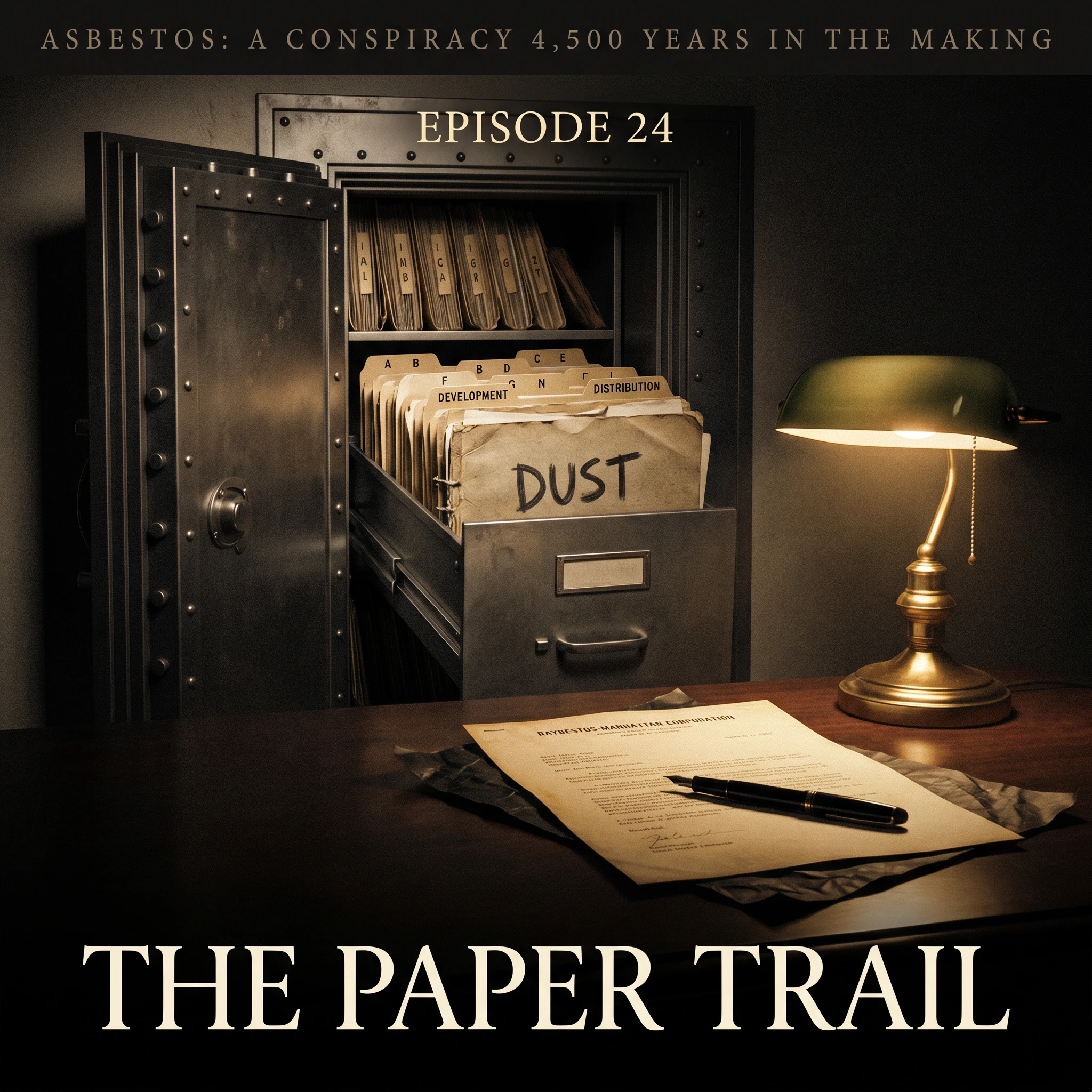
The vault belonged to Sumner Simpson, president of Raybestos-Manhattan Corporation from 1929 until his death in 1953. Filed alphabetically, right there between "Development" and "Distribution": DUST. Approximately 6,000 documents. Undisturbed for forty-four years.
Key Takeaways
- 1933 — The first lawsuit is settled into silence. Eleven workers sue Johns-Manville for failing to provide ventilation and safety equipment. Settlement: $30,000 total — $2,700 per worker. Conditions: their attorney agrees never to file another asbestos case; terms stay confidential. Internal meeting minutes that same year: "Our past policy of keeping this matter confidential is to be pursued."
- 1931–1936 — The Lanza study is rewritten before publication. Dr. Anthony Lanza's original draft: asbestosis could "result fatally." After Vandiver Brown directs changes, the published JAMA version concludes asbestosis "did not result in any marked disability." New Jersey does not recognize asbestosis as compensable for workers' compensation until 1945 — a 10-year delay the altered study helped enable.
- September 25, 1935 — The Rossiter letter. A.F. Rossiter, editor of Asbestos magazine, writes to Sumner Simpson: "Always you have requested that for certain obvious reasons we publish nothing, and, naturally your wishes have been respected." Confirming years of pre-existing censorship. In writing. On letterhead.
- October 1–3, 1935 — The exchange. Simpson to Brown: "I think the less said about asbestos, the better off we are." Brown to Simpson, two days later: "I quite agree with you that our interests are best served by having asbestosis receive the minimum of publicity."
- 1936–1947 — The Gardner coverup is orchestrated. Dr. LeRoy Gardner induces malignant tumors in mice at 81.8%, documents 11 human lung cancer cases including 2 mesotheliomas. He dies in 1946. At a January 1947 meeting, companies agree the cancer references "should be deleted." Brown documents his own instructions: "All references to cancers and tumors deleted."
- 1949 — Dr. Kenneth Smith's memo. Johns-Manville's physician recommends sick workers "should not be told of his condition so that he can live and work in peace, and the company can benefit by his many years of experience." Three years later, Smith recommends warning labels. Management refuses — a "business decision" because labels would "cut into sales."
- April 25, 1984 — Federal court testimony. Charles Roemer testifies that at a c. 1942–43 meeting, he asked Vandiver Brown whether the company would really let sick workers keep working until they died. Brown's response: "Yes. We save a lot of money that way."
The Vault
The files existed because Sumner Simpson was a careful businessman. He kept correspondence. He maintained records. He co-founded the University of Bridgeport in 1927, eight years before writing the "less said" letter. He was a civic figure, a community builder, someone who understood institutional legacies. And between 1933 and 1953, he also maintained a locked safe containing two decades of company strategy regarding asbestos disease.
The documents were alphabetically organized. Under "D": Development. Distribution. DUST.
Documents stored in the DUST vault at Raybestos-Manhattan headquarters — preserved for 44 years using standard 1930s business practices
When Simpson died in June 1953 at age 79, the vault passed to his son. For twenty-four more years — while workers kept getting sick and kept being told nothing — the papers sat there. Perfectly preserved. When the safe was finally opened during litigation in 1977, everything inside was intact. Carbon copies. Letterhead. Signatures in ink. The evidence of a conspiracy, maintained by the conspiracy itself.
The 1933 Settlement: Silence as a Contract Term
The paper trail begins in 1933 with what looks like a legal resolution. Eleven asbestos workers in New Jersey file suit against Johns-Manville for failing to provide adequate ventilation and safety equipment. The case settles. Thirty thousand dollars total — $2,700 per worker. Two conditions: their attorney agrees to never file another asbestos case, and the settlement terms stay confidential.
Internal Johns-Manville meeting minutes that same year document the strategic framing: "Our past policy of keeping this matter confidential is to be pursued."
Settlement per worker in the 1933 Johns-Manville lawsuit — with a contractual clause preventing their attorney from filing another asbestos case
The settlement wasn't just compensation. It was the purchase of silence — formalized into a legal agreement, filed in the DUST cabinet, maintained for four decades as the template for how to contain the asbestos liability problem.
The Lanza Study: A Conclusion Rewritten
In 1931, Dr. Anthony Lanza — Assistant Medical Director at Metropolitan Life Insurance Company — began studying asbestos workers at a Johns-Manville plant in Waukegan, Illinois. His methodology was sound. His findings were consequential. His original draft said asbestosis could "result fatally."
Vandiver Brown, Johns-Manville's general counsel and vice president, reviewed the draft before submission. The correspondence documents what happened next. Brown directed specific changes to Lanza's language. The published version — JAMA, February 1936 — concluded that asbestosis "did not result in any marked disability."
The consequences were durable. New Jersey did not recognize asbestosis as compensable under workers' compensation until 1945. That is a ten-year delay, during which workers who developed the disease had no legal recourse — aided by a scientific publication that said what Brown needed it to say.
Delay before New Jersey recognized asbestosis as compensable under workers' compensation — enabled in part by Lanza's altered 1936 JAMA study
The Rossiter Letter and the "Less Said" Exchange
On September 25, 1935, A.F. Rossiter — editor of Asbestos magazine, writing from Philadelphia — sent a letter to Sumner Simpson. Her opening confirmed what had been true for years: "Always you have requested that for certain obvious reasons we publish nothing, and, naturally your wishes have been respected."
She was confirming an arrangement. A censorship relationship. Not a new one — an existing one, already in practice for an unspecified time before 1935.
Six days later, Simpson wrote to Vandiver Brown. Eight words on Raybestos-Manhattan letterhead: "I think the less said about asbestos, the better off we are."
Brown's reply came two days after that: "I quite agree with you that our interests are best served by having asbestosis receive the minimum of publicity."
Three letters. Each confirming the same arrangement. Each preserved using carbon copies. Each filed under DUST.
The Gardner Coverup: Documented in Brown's Own Hand
Dr. LeRoy Gardner directed the Saranac Laboratory for Research on Tuberculosis in the Adirondacks. From 1936, nine asbestos companies funded his research under a publication veto clause — if the companies didn't approve the findings, the findings didn't publish. Episode 22 documented how that clause was used. Episode 24 adds what Brown wrote afterward.
By 1942 to 1943, Gardner had induced malignant tumors in chrysotile-exposed mice at an 81.8% rate — sixteen times the background rate for other dusts. He had also documented 11 human lung cancer cases from Quebec asbestos miners, including 2 mesotheliomas. He died in October 1946 before his work could be published.
At a meeting in January 1947, the nine companies voted on what to do with Gardner's findings. The meeting minutes record the decision: the reference to cancer and tumors "should be deleted." Brown's own summary of what he instructed: "All references to cancers and tumors deleted."
Malignant tumor rate in Gardner's 1943 mouse study — suppressed by unanimous industry vote in January 1947, deleted from the published record in Brown's own handwriting
The Smith Memo: "Live and Work in Peace"
In 1949, Dr. Kenneth Smith — a Johns-Manville physician — evaluated workers whose chest X-rays showed early-stage asbestosis. His recommendation, preserved in writing, was that these workers "should not be told of his condition so that he can live and work in peace, and the company can benefit by his many years of experience."
In 1952, Smith became medical director of all Johns-Manville companies. That same year, he recommended placing warning labels on asbestos products. Management refused. The refusal was characterized as a "business decision." The reasoning: labels would "cut into sales."
Both the recommendation and the refusal are documented. Both sit in the record that opened in 1977. The Smith memo became, across thousands of asbestos lawsuits, one of the most frequently cited documents establishing what Johns-Manville knew and chose not to share with the workers whose lungs were filling with asbestos fibers while their supervisors read the X-rays and said nothing.
The Roemer Testimony: "We Save a Lot of Money That Way"
On April 25, 1984, former Unarco employee Charles Roemer testified in the federal case Johns-Manville Corporation v. The United States of America. He described a meeting approximately 1942 to 1943 at which Vandiver Brown was present. Roemer asked Brown directly: would the company really continue employing workers it knew were sick until they died?
Brown's response: "Yes. We save a lot of money that way."
Roemer testified to this under oath, in federal court, forty years after the meeting. The statement is in the court record. It is not a reconstruction or an allegation. It is sworn testimony preserved in the same federal archives that house the case documents and the Simpson Papers.
Why This Matters If You Were Exposed
The documents in the DUST vault were generated between 1933 and 1943. But mesothelioma has a latency period of 20 to 50 years. Workers who inhaled asbestos in the 1950s, 1960s, and 1970s — in shipyards, factories, construction sites, refineries, and automotive shops — are being diagnosed today. What the companies knew in 1943 is directly relevant to what happened to workers decades later.
The Simpson Papers, the Lanza correspondence, the Gardner suppression vote, the Smith memo, the Roemer testimony — these documents were not academic history. They were introduced as evidence in the cases that established asbestos company liability for the disease your family member may be living with right now. The paper trail from the DUST vault is the same paper trail that funds the $30 billion in asbestos trust funds available to victims today.
If you or a family member was exposed to asbestos at work and has been diagnosed with mesothelioma, Danziger & De Llano has recovered nearly $2 billion for families over 30 years of mesothelioma litigation. A free consultation can determine whether you qualify for compensation through trust funds, litigation, or VA benefits.
The DUST vault sat undisturbed — 1933 to 1977 — while workers kept getting sick and the industry kept saying the science was inconclusive
The Timeline: 1933–1984
| Date | Document / Event | Significance |
|---|---|---|
| 1933 | 11-worker lawsuit settled; attorney barred from future asbestos cases | Establishes silence as a contractual term; internal minutes confirm "confidential" policy to continue |
| 1931–1936 | Lanza study revised by Brown before publication | "Result fatally" becomes "did not result in any marked disability" — delays NJ workers' comp by 10 years |
| September 25, 1935 | Rossiter letter confirming years of pre-existing media censorship | "Always you have requested that we publish nothing" — the arrangement was not new in 1935 |
| October 1, 1935 | Simpson to Brown: "The less said about asbestos, the better off we are" | Eight words on corporate letterhead documenting a coordinated suppression strategy |
| October 3, 1935 | Brown to Simpson: "minimum of publicity" reply | Confirms the strategy is shared across companies, not just Raybestos-Manhattan |
| 1941 | Brown writes the "ostrich-like attitude" letter | Internal acknowledgment that the industry knows what it's doing and has chosen to continue |
| 1942–1943 | Gardner documents 81.8% tumor rate and 11 human cancer cases | The most significant cancer finding the industry funded — suppressed the same year |
| January 1947 | Nine companies vote to delete all cancer references from Gardner's report | Brown documents his own instruction: "All references to cancers and tumors deleted" |
| 1949 | Smith memo: don't tell sick workers their diagnosis | Workers with asbestosis on X-ray are kept working — "the company can benefit by his many years of experience" |
| 1952 | Smith recommends warning labels; management refuses as "business decision" | Labels would "cut into sales" — the commercial rationale for keeping workers uninformed is documented |
| June 15, 1953 | Sumner Simpson dies; vault passes to his son | The documents continue to sit undisturbed for 24 more years |
| 1977 | Simpson vault discovered during litigation | 44 years of suppression strategy enters the legal record; becomes evidence in thousands of lawsuits |
| April 25, 1984 | Roemer testimony: "Yes. We save a lot of money that way." | Sworn federal court testimony confirms what the documents already proved |
Arc 5: The Conspiracy Was Always on Paper
Arc 5, "The Conspiracy Begins," opened with private letters (Episode 20), revealed the trade association apparatus (Episode 21), exposed the purchased-science model (Episode 22), and documented the scale of the suppression network (Episode 23). Episode 24 closes the arc by doing something the first four episodes could not do alone: presenting the actual documents.
The conspiracy didn't rely on verbal agreements or unwritten understandings. It relied on normal business practices. Letterhead. Carbon copies. Filed memos. Meeting minutes. The people who built it maintained records because that's what executives do. What they didn't anticipate was that a locked safe labeled DUST would still be there 44 years later, waiting to be opened.
Arc 6 begins next episode: "Magic Mineral at War." They knew asbestos caused cancer in 1943. Then came World War II and the shipyards — the largest single asbestos exposure event in American history.
About This Podcast
Asbestos: A Conspiracy 4,500 Years in the Making is a 52-episode documentary podcast series produced by Danziger & De Llano, LLP. The series traces the complete history of asbestos — from 4700 BCE to the 2024 EPA ban — revealing how a substance known for millennia as the "Magic Mineral" became one of history's deadliest industrial cover-ups.
Each episode combines archival research, historical analysis, and modern medical and legal context to document how corporations suppressed evidence of asbestos danger while workers and families died. Over 30 years, Danziger & De Llano has recovered nearly $2 billion for families affected by asbestos exposure. If you or a family member was exposed to asbestos and have questions about mesothelioma, compensation, or your legal rights, visit dandell.com for a free consultation.
The Asbestos Podcast is part of the MESO podcast network, dedicated to education and advocacy for mesothelioma victims and their families.
The complete episode transcript with citations, key facts, and additional context is available on WikiMesothelioma.com — our open educational resource for asbestos and mesothelioma information.
Meet the Team Behind This Episode

Founding Partner, Danziger & De Llano
Founding Partner at Danziger & De Llano with over 30 years of mesothelioma litigation experience. Co-executive producer of Puncture (2011).

Founding Partner, Danziger & De Llano
Founding Partner at Danziger & De Llano. Former Jones Day corporate defense attorney who switched sides after seeing firsthand what asbestos companies did to workers. Over $1 billion recovered for mesothelioma families.
Senior Client Advocate, Danziger & De Llano
Senior Client Advocate and Military Veteran Specialist at Danziger & De Llano. His father, Dan Gates, died of mesothelioma after working at a Shell refinery in Pasadena, Texas. Larry has dedicated his career to helping families like his.
Related Resources
Topics
Were You or a Loved One Exposed to Asbestos?
The history in this episode isn't just history. If you worked with asbestos products, lived in a home built with asbestos materials, or were exposed through a family member's work clothes, you may have legal options. Danziger & De Llano has spent 30+ years and recovered nearly $2 billion for asbestos victims.