What This Episode Covers
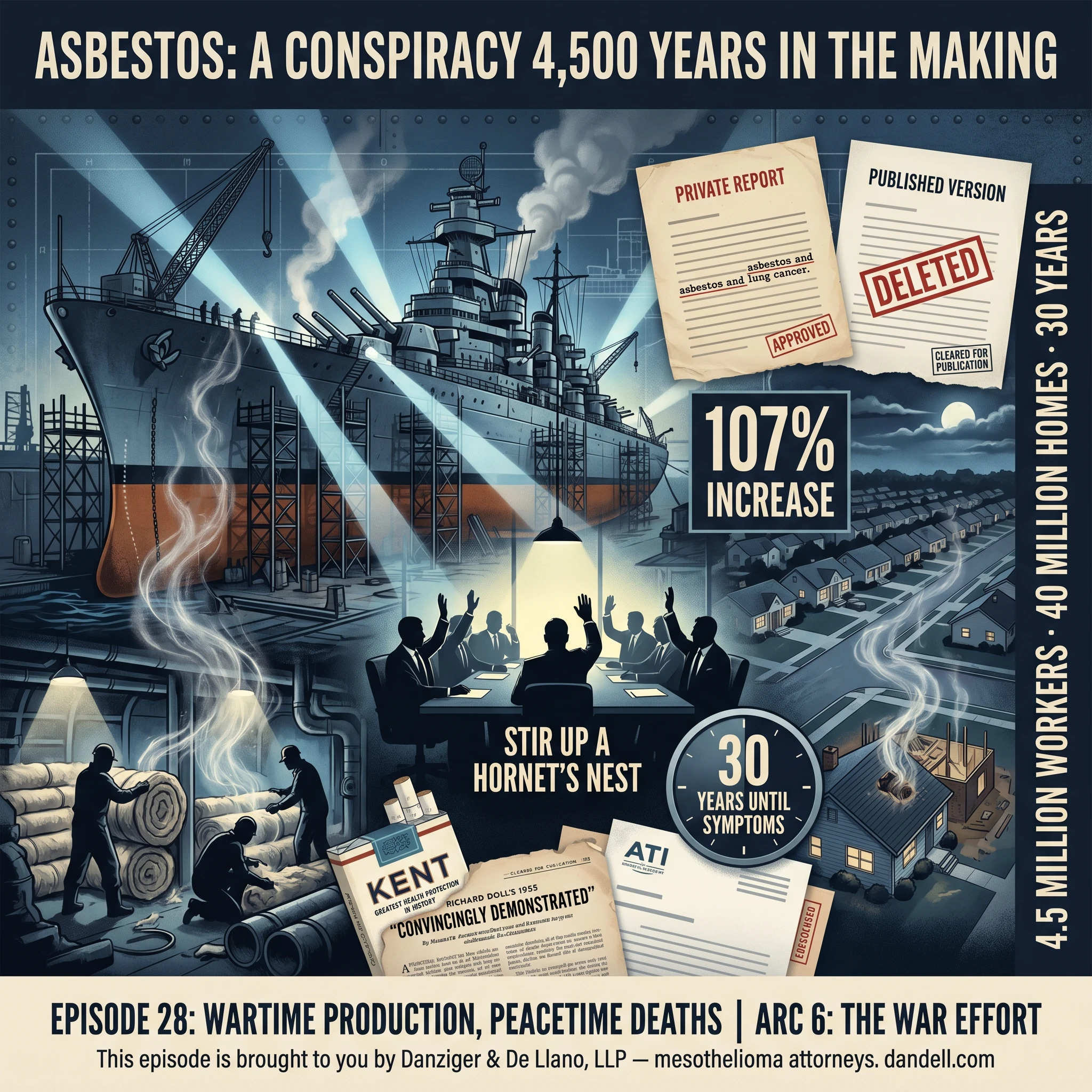
Japan surrendered on September 2, 1945, aboard the USS Missouri — a ship built at the Brooklyn Navy Yard with 300 tons of asbestos insulation. The war was over. Wartime production should have declined. Instead, U.S. asbestos consumption increased 107% in the decade that followed — from 343,000 to 709,000 tons. The emergency was over. The market had just begun.
Episode 28 covers four decades of decisions: the industry votes in 1947, the housing boom that put asbestos in 40 million American homes, the Braun-Truan study fraud, the latency clock that protected executives from accountability, and the mathematics of a crime where the witnesses die before the cases appear.
Key Takeaways
- 107% production increase, 1945-1955. U.S. asbestos consumption rose from 343,000 to 709,000 tons in peacetime. The GI Bill drove 8 million veterans to buy homes. Homeownership rose from 43% to 62%. Forty million homes were built — and every one of them contained asbestos.
- The ATI voted 6-2 against cancer research in March 1947. Their recorded reason: it would "stir up a hornet's nest and put the whole industry under suspicion." Twelve years after Sumner Simpson's letter. Same companies. Same calculation.
- The Braun-Truan fraud entered the medical literature. The private report showed asbestosis increases cancer risk. The published version deleted that finding. A 1960 medical textbook cited the fraudulent version as fact, teaching physicians the opposite of what the research showed.
- Richard Doll published anyway, 1955. Despite "determined attempts to dissuade" him, Doll's British study showed asbestos-lung cancer evidence "convincingly demonstrated." The U.S. industry suppressed the finding for another 20 years.
- Kent cigarettes filtered with crocidolite asbestos, 1952-1956. Thirty percent crocidolite — the most dangerous variety — in the Micronite filter. Marketing slogan: "Greatest health protection in history."
- Brooklyn Navy Yard closed June 30, 1966. Not 1945. Twenty-one years after the war. Charleston Naval Shipyard: April 1, 1996. Fifty-one years after the war. Workers exposed in the 1980s may not develop mesothelioma until 2030.
- The latency math is the mechanism of the crime. A 25-year-old worker exposed in 1943 doesn't develop symptoms until 1973. By then he's a grandfather. The executives who suppressed the 1947 research are retired or dead. The documents are in sealed corporate archives. Thirty-year delay. Witnesses gone. Victim with no connection to the dust.
The Production Paradox
In 1945, U.S. asbestos consumption was 343,000 tons. In 1955, it was 709,000 tons. A 107% increase in peacetime. The wartime shipbuilding program had ended. The Brooklyn Navy Yard's production of destroyers and aircraft carriers had slowed. Where did the demand go?
Forty million homes. Between 1945 and 1975, American construction absorbed more asbestos than the wartime fleet had required. Floor tiles: 40 to 70 percent asbestos in the backing. Joint compound: 3 to 6 percent, standard specification. Popcorn ceilings: 1 to 10 percent. Roofing, siding, pipe insulation. By 1958, asbestos appeared in approximately 3,000 applications. The Quebec Asbestos Information Service called it "the magic mineral." The marketing was accurate about the fireproofing. It omitted the carcinogen.
Increase in U.S. asbestos consumption from 1945 to 1955 — from 343,000 to 709,000 tons — driven by postwar housing construction, not wartime production
Levittown, New York, 1947 to 1951: 17,447 homes. Asbestos siding. Asbestos roofing. Nine-by-nine floor tiles — which by the "Rule of Nines" are 99% likely to contain asbestos. Joint compound as standard. These weren't luxury materials. They were the cheapest, most durable option the industry could produce, and the government-backed housing programs moved them into working-class homes at scale. Eight million veterans used the GI Bill. Homeownership rose from 43% in 1940 to 62% by 1960. The workers who had survived the shipyards went home — to houses full of asbestos.
The 1947 Votes and the Braun-Truan Fraud
In January 1947, Saranac Laboratory industry sponsors held a meeting. Their agreement: no research would be published without group consent. Publications would not include "any objectionable material." The category of objectionable material was defined: any connection between asbestos and cancer. In January 1951, the sanitized Saranac report appeared — every cancer reference removed.
In March 1947, the Asbestos Textile Institute voted on whether to commission an epidemiological study on lung cancer. Six to two against. Their recorded reason: "Such an investigation would stir up a hornet's nest and put the whole industry under suspicion."
The ATI vote in March 1947 against commissioning cancer research — because it would "stir up a hornet's nest." The vote and the language are in their own minutes.
In 1957, the Quebec Asbestos Mining Association funded a study through the Industrial Hygiene Foundation. Researchers Daniel Braun and T. David Truan produced two versions. Their private report to the Mining Association: "The results suggest that a miner who develops asbestosis does have a greater likelihood of developing cancer of the lung." The published version deleted that finding. Journal editor Herbert Stokinger wrote that he was "particularly pleased to learn the main conclusion was against the association of lung cancer with asbestosis." Rutherford Johnstone's 1960 medical textbook cited the published Braun-Truan version as evidence that asbestosis does NOT cause lung cancer. A fraudulent finding, in a textbook, teaching a generation of physicians the wrong answer.
Meanwhile, in 1955, Richard Doll published in the British Journal of Industrial Medicine — despite, he noted, "determined attempts to dissuade" him. His finding: the evidence "convincingly demonstrated so substantial an excess of lung cancer in heavily exposed long-term asbestos workers as to overcome honest doubt." The U.S. industry suppressed this evidence for another 20 years.
Kent Cigarettes and the Wizard of Oz
Between 1952 and 1956, Kent cigarettes used the "Micronite" filter — 30 percent crocidolite asbestos, the most dangerous variety, 10 milligrams per filter. The marketing slogan: "Greatest health protection in history." Lorillard sold 13 billion Kent cigarettes during those four years.
The poppy field scene in The Wizard of Oz used fake snow — chrysotile asbestos, branded as "Pure White Fire Proof Snow." By 1958, asbestos appeared in approximately 3,000 applications. Not all of them were industrial.
Shipyards That Kept Running
The war ended in 1945. The shipyards did not close. Brooklyn Navy Yard operated until June 30, 1966 — building the USS Saratoga (1952-1956), the USS Constellation (1957-1961), and finally the USS Duluth, launched August 1965. Nine thousand five hundred workers at closure. Twenty-one years after the war.
Charleston Naval Shipyard closed April 1, 1996. Fifty-one years after the war. Workers exposed there in the 1980s — well after everyone in the industry knew about mesothelioma — may not develop the disease until 2010, 2020, or 2030. The latency clock doesn't respect historical periods.
The Latency Clock and the Perfect Crime
Mesothelioma's latency period: 20 to 60 years, median 32 to 38 years. A worker exposed at Brooklyn in 1943 at age 25 would not typically develop symptoms until 1973. By then he is 55. A grandfather. He may have worked 39 years at a dairy like James Cook — a boatswain's mate on the USS Wisconsin who came home to Norfolk and spent the rest of his working life at Birtcherd Dairy, rising to distribution manager. At 94, Cook found a dollar yard-sale model of the Wisconsin and could still point to where his gun station was on the fantail. The article about him doesn't say whether he got sick. Most of these stories don't have recorded endings. Or the endings came in a doctor's office, thirty years later, with no connection to the ship.
WWII shipyard workers who went home after the war — many with asbestos exposure they didn't know about, with a latency clock that wouldn't strike for decades
The executives who voted 6-2 against cancer research in 1947 were retired or dead by the time the cases appeared. The documents were in sealed corporate archives. The worker had no idea who to blame — or even what caused the cough. Industry data from the 1940s and 1950s showed that 20 percent of the workforce had developed asbestos disease. Corporate policy: don't tell them. Thirty-year delay. Witnesses gone. Evidence buried. The victim has no connection to the dust. That is the arithmetic of the thing.
Unions and the Postwar Accord
Four and a half million shipyard workers had unions. After the war, labor historians describe what happened as "the postwar accord" — unions ceded control over workplace conditions to management in exchange for better wages, shorter hours, and health insurance. If workplace safety was management's responsibility, safety advocacy was no longer labor's fight. In 1947, the same year as the ATI vote, Congress passed Taft-Hartley: closed shops outlawed, solidarity strikes banned, union officers required to sign anti-communist affidavits. In 1949 and 1950, the CIO expelled 11 left-led unions — approximately one million members, one-third of CIO membership. The unions that had been most militant on workplace conditions were gone. Doll's 1955 paper was published in Britain; it wasn't widely circulated to American unions. The companies had evidence that 20 percent of their workers had developed asbestos disease. Policy: silence.
If You Were Exposed
Mesothelioma compensation is available for workers who were exposed to asbestos in any of the 3,000 applications documented by 1958 — shipyards, home construction, cigarette filters, or any other source. Family members who experienced secondary exposure through work clothing also qualify. Over $30 billion remains available in asbestos trust funds.
For a free consultation, Danziger & De Llano has recovered nearly $2 billion for mesothelioma families over 30 years of litigation. Veterans who worked in Navy shipyards that continued operating through the 1980s may also qualify for VA benefits.
About This Podcast
Asbestos: A Conspiracy 4,500 Years in the Making is a 52-episode documentary podcast series produced by Danziger & De Llano, LLP. The series traces the complete history of asbestos — from 4700 BCE to the 2024 EPA ban — revealing how a substance known for millennia as the "Magic Mineral" became one of history's deadliest industrial cover-ups.
Each episode combines archival research, historical analysis, and modern medical and legal context to document how corporations suppressed evidence of asbestos danger while workers and families died. Over 30 years, Danziger & De Llano has recovered nearly $2 billion for families affected by asbestos exposure. If you or a family member was exposed to asbestos and have questions about mesothelioma, compensation, or your legal rights, visit dandell.com for a free consultation.
The complete episode transcript with citations, key facts, and additional context is available on WikiMesothelioma.com — our open educational resource for asbestos and mesothelioma information.
Meet the Team Behind This Episode

Director of Patient Support, Danziger & De Llano
Director of Patient Support at Danziger & De Llano with nearly fifteen years of experience helping mesothelioma families. She lost her own husband to cancer. She brings personal understanding to every family she works with.
Related Resources
Topics
Were You or a Loved One Exposed to Asbestos?
The history in this episode isn't just history. If you worked with asbestos products, lived in a home built with asbestos materials, or were exposed through a family member's work clothes, you may have legal options. Danziger & De Llano has spent 30+ years and recovered nearly $2 billion for asbestos victims.